What is Tabla?
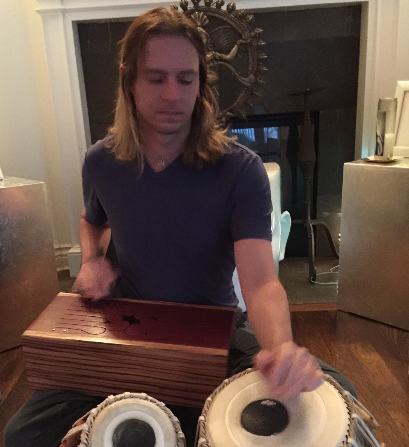
Tabla is a pair of hand-played percussion instruments consisting of two drums: the dayan (also called tabla), a smaller wooden drum played with the right hand that produces higher-pitched tones, and the bayan (also called dagga), a larger metal drum played with the left hand that produces bass tones. Both drums feature a distinctive black paste called syahi made from iron filings, soot, and gum applied to the drumhead center, which enables the instrument’s characteristic melodic resonance and allows players to produce a wide range of pitches and timbres. The tabla is the primary percussion instrument in Hindustani (North Indian) classical music and has become synonymous with Indian rhythm worldwide.
Origins & Lineage
The tabla most likely emerged between the late 1600s and late 1700s in North India, though its precise origins remain debated among scholars. Popular legend attributes the invention to Amir Khusrau (1253-1325), the celebrated Sufi poet and musician at the Delhi Sultanate court, who supposedly split the traditional pakhawaj drum in half to create greater flexibility for accompanying the khyal vocal style. However, Abul Fazl, court historian of the Mughal period, made no mention of such an invention, and modern research finds no documentary evidence of the tabla as we know it until the 18th century.
The instrument developed as Persian, Arabic, and Turkish musical traditions blended with indigenous Indian drumming during the Mughal period (1526-1857). The pakhawaj, a two-headed barrel drum used in dhrupad singing, was the predecessor instrument. The tabla’s emergence coincided with the rise of khyal, a more ornate and flexible vocal genre than dhrupad, which required accompaniment capable of intricate rhythmic improvisation. By the late 18th and early 19th centuries, Muslim tabla players had established themselves in royal courts (durbars) accompanying vocalists, instrumentalists, and Kathak dancers, while developing sophisticated solo repertoires.
The gharana (literally ‘household’) system formalized tabla lineages beginning in the 18th century. Six major gharanas preserve distinct playing styles and compositional approaches: Delhi, Ajrada, Lucknow, Farukhabad, Benares, and Punjab. Each traces its lineage through specific master-disciple chains and maintains characteristic techniques (baj), though these boundaries have softened in the modern era.
How It’s Practiced
Tabla playing requires years of disciplined study, traditionally beginning with oral transmission of rhythmic syllables called bols—vocalized phonemes like ‘dha,’ ‘tin,’ ‘na,’ ‘ge,’ and ‘ke’ that correspond to specific strokes on the drums. Students learn to recite complex rhythmic compositions (kaidas, relas, tukras, chakradars) before playing them, internalizing the mathematical structure of tala (rhythmic cycles) ranging from simple 6- or 7-beat patterns to elaborate 16-beat teentaal or rare 14-beat dhamar.
The physical technique demands precise finger control, wrist flexibility, and independence of hands. The right hand executes resonant, pitched strokes on the dayan using fingers, palm, and the base of the hand in varying combinations. The left hand manipulates the bayan’s pitch by pressing the heel of the palm against the drumhead while striking, creating slides, bass tones, and harmonic effects. Proper tuning involves adjusting leather straps and wooden dowels around each drum’s circumference—a skill requiring trained ears to match the tonic (sa) of accompanying melody instruments.
In performance, the tabla player provides both timekeeping and improvisational counterpoint. During instrumental or vocal solos, the accompanist marks the rhythmic cycle, emphasizes important structural points (the sam, or first beat), and engages in rhythmic dialogue with the soloist. In tabla solo concerts, the player demonstrates mastery through composed pieces and spontaneous improvisation (layakari) exploring divisions and subdivisions of the beat.
Tabla Today
Contemporary seekers encounter tabla through multiple pathways. In traditional Hindustani classical concerts, tabla remains essential accompaniment for sitar, sarod, bansuri, and vocal performances, with masters like Zakir Hussain having achieved international recognition. World music festivals and fusion collaborations have introduced tabla to jazz, electronica, and world beat genres, expanding its context beyond classical confines.
Tabla instruction is now available worldwide through both traditional guru-shishya (teacher-student) relationships and institutional music schools. Online learning platforms, YouTube channels, and apps like iTabla Pro offer instructional content, though serious students still seek direct transmission from lineage holders. Recording artists from Ali Akbar Khan to Anoushka Shankar feature tabla prominently, making the sound accessible to global audiences.
In spiritual and conscious music contexts, tabla appears in kirtan (devotional chanting), qawwali Sufi gatherings, and yoga studios accompanying mantra singing. The instrument’s meditative practice—the repetitive discipline of bols, the focus required for rhythmic precision—aligns with contemplative traditions, though this application differs from the classical performance context where tabla originated.
Common Misconceptions
Tabla is not a single drum but a pair of drums requiring coordinated two-hand technique. It is not ancient in its current form—the instrument as played today dates to the 18th century, not to Vedic times, despite some claims connecting it to earlier percussion traditions. The attribution to Amir Khusrau, while culturally significant, is legendary rather than historically documented.
Tabla is not interchangeable with other Indian drums like mridangam (used in Carnatic/South Indian music), pakhawaj (used for dhrupad), or dholak (folk music). Each serves distinct musical traditions with different construction, technique, and repertoire. The tabla is not purely accompaniment—solo tabla performance is a respected concert genre with sophisticated compositional forms.
The instrument is not easy to self-teach. While modern technology provides resources, tabla technique requires correction of subtle hand positions and stroke quality that typically demands in-person guidance. The traditional secrecy of gharanas, while diminishing, means that certain advanced compositions and techniques remain closely held within lineage communities.
How to Begin
Beginners should start by finding a qualified teacher, ideally one trained in a recognized gharana tradition. Local Indian cultural centers, university music departments, or online directories can connect students with instructors. Purchasing quality instruments matters—student-level tabla sets cost $300-800, while professional instruments exceed $1,500. Avoid tourist-quality decorative drums that cannot be properly tuned.
Essential introductory resources include Robert S. Gottlieb’s Solo Tabla Drumming of North India (Motilal Banarsidass, 1993) for English-language analysis, and James Kippen’s ethnomusicological work documenting the Lucknow gharana. Recordings by Alla Rakha, Zakir Hussain, and Kumar Bose demonstrate classical mastery. David Courtney’s pedagogical materials and the website SangeetaAbhinava.com offer structured learning paths.
Expect initial months focused solely on basic bols and single-hand technique. Traditional training begins with thekas (fixed patterns marking tala cycles) before progressing to compositional forms. Daily 30-60 minute practice develops the finger strength and rhythmic internalization required. Attending live Hindustani classical concerts—whether in person or via platforms like Darbar Festival’s archive—trains the ear to hear how tabla functions within ensemble context and provides inspiration for the long study ahead.